

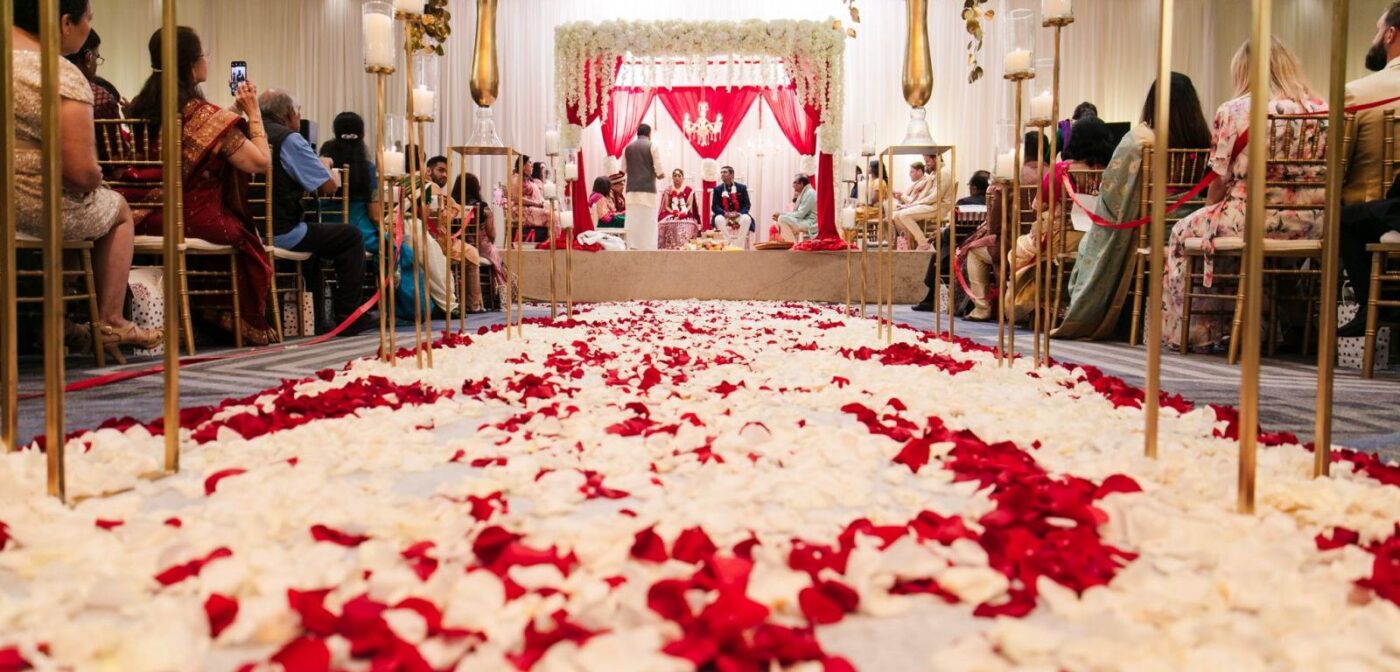
Search “Indian wedding DJ Dallas” and almost everything you find is written for a Punjabi baraat and a Bollywood-heavy sangeet. That’s a real and large slice of DFW’s South Asian wedding market — but it isn’t the whole picture. Dallas–Fort Worth has one of the fastest-growing Telugu and Tamil communities in the country, concentrated in Irving, Plano, Frisco, and Richardson, and a Telugu or Tamil wedding runs on a genuinely different structure, timeline, and soundtrack. Hiring a DJ who treats it as “an Indian wedding, generic version” is how couples end up explaining their own ceremony to their own vendor.
Why South Indian weddings need a different planning conversation
The biggest difference isn’t music — it’s timing. A Telugu or Tamil wedding is built around the Muhurtham, the precise auspicious moment (often calculated to the minute by a family priest or astrologer) when the core rituals must happen. Unlike a Punjabi baraat, where the procession and reception can flex around the DJ’s set list, the Muhurtham does not move for anyone — not the caterer, not the photographer, and not the DJ. A DJ who doesn’t understand this will try to “keep the energy up” through a ceremony that isn’t supposed to have a DJ-driven energy at all during its most sacred minutes.
The right approach is the same one we use for every South Asian tradition we work with: ask the family what the ceremony needs, rather than assuming. For a Telugu or Tamil wedding, that usually means near-total restraint during the ceremony itself — the traditional Nadaswaram and Thavil (temple wind and percussion instruments) or a live priest’s chanting carry the ceremony, not a DJ booth. Our job during those hours is logistics: clean audio for the priest’s mic, a reliable cue system with the photographer and videographer, and zero interruptions during rituals like Kanyadanam (the giving away of the bride), the tying of the Mangalsutra or thaali, and the Saptapadi (seven steps taken together around the sacred fire).
Telugu weddings: what a DJ needs to know
Telugu weddings layer in moments that a Punjabi-wedding-only DJ has never staged before. Jeelakarra Bellam, where the bride and groom place a paste of cumin and jaggery on each other’s heads, and Talambralu, the joyful shower of turmeric-coated rice the couple throw over each other, are both high-energy, high-emotion, highly photographed moments — and both need a specific, brief musical cue rather than a generic upbeat track, because families often want a particular devotional or filmi song tied to that exact ritual. The pre-wedding Kashi Yatra, where the groom mock-departs for a life of renunciation before being “convinced” to marry, is playful and often gets genuine laughs from the crowd — it deserves light, comic musical timing, not silence and not a full DJ set.
Where a DJ’s regular skill set does apply fully is the reception. Telugu wedding receptions increasingly run like any other DFW South Asian reception — couple entrance, family dances, open floor — but the soundtrack should include real Tollywood staples (Telugu film music) alongside Bollywood and Western hits, not just Hindi filler standing in for the couple’s own language and culture.
Tamil weddings: what a DJ needs to know
Tamil weddings carry their own sequence: Nichayathartham (the formal engagement), the Oonjal ceremony where the bride and groom are seated on a swing and gently rocked while relatives sing traditional songs, and Mangalyadharanam, the thaali-tying moment that is the emotional peak of the entire ceremony. The Oonjal in particular is a live-singing tradition — family members, not a DJ, carry the moment vocally, and a DJ’s role is to make sure the room can hear them, not to compete with them. As with Telugu weddings, the ceremony’s Muhurtham is fixed, and the DJ’s job is precision and restraint until the family signals it’s time to open the floor.
Tamil receptions lean into Kollywood (Tamil film) music alongside Bollywood, Western, and increasingly K-pop or Afrobeats requests from younger cousins — DFW’s South Indian second generation has broad, mixed playlists, and a DJ who only knows the Bollywood catalog will visibly miss requests the room actually wants.
One DJ, two very different halves of the day
What makes Telugu and Tamil weddings distinct from a planning standpoint is that they genuinely split into two different jobs inside a single event: a quiet, precision-timed ceremony where the DJ supports live traditional musicians and priests rather than performing, and a full-energy reception where the DJ carries the room the way they would at any other South Asian celebration. A DJ who’s only ever done Punjabi baraats will over-perform the first half and a DJ who’s only done South Indian ceremonies may under-deliver the second. The families who tell us their last wedding “felt disconnected” almost always mean exactly this — a vendor who was strong in one half and checked out in the other.
Questions worth asking before you book
- Has the DJ worked a Telugu or Tamil ceremony before, and can they name specific rituals unprompted — Muhurtham, Kanyadanam, Talambralu, Oonjal, Mangalyadharanam?
- Will they coordinate directly with the priest and the family’s ritual timeline, not just the venue’s run-of-show?
- Do they have a real Tollywood and Kollywood library, or are they planning to “figure it out” from a Spotify search the week of?
- Will they ask your family what each specific moment needs, rather than defaulting to what worked at a different couple’s wedding?
Bringing it to Dallas–Fort Worth
Irving, Plano, Frisco, and Richardson have grown into genuine hubs for Telugu and Tamil families in DFW, and local venues are increasingly comfortable hosting the full sequence — Muhurtham-timed ceremony through late-night reception — in one location. What matters most on the DJ side isn’t a bigger speaker rig; it’s a vendor who has actually planned a Telugu or Tamil wedding timeline before and won’t be improvising your family’s rituals in real time.
If you’re planning a Telugu or Tamil wedding in Dallas–Fort Worth, tell us about your ceremony’s structure early — the Muhurtham timing, which rituals your family observes, and what your reception soundtrack should actually sound like. We’ll build the day around your traditions, not a generic South Asian template.
