

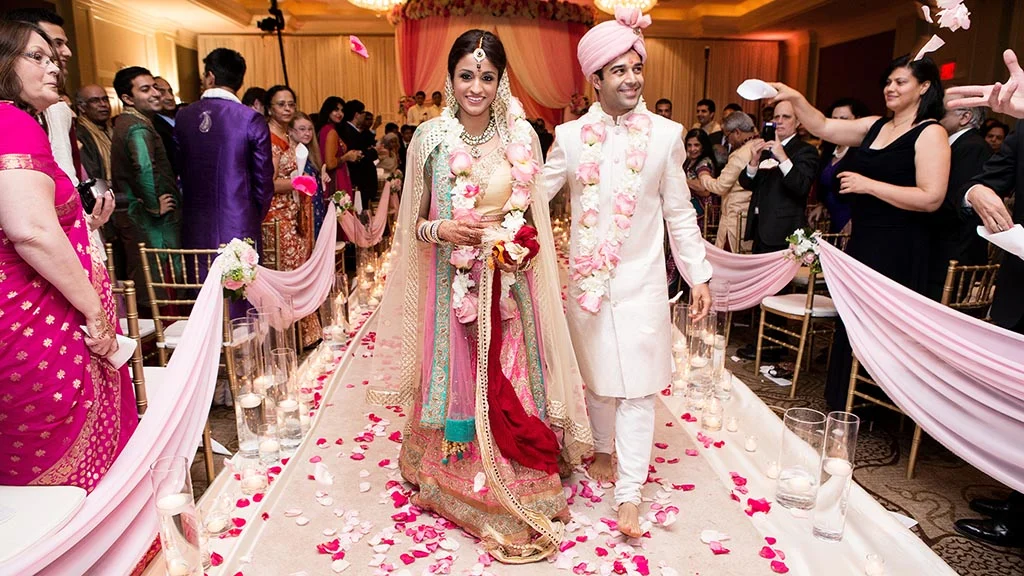
A multicultural wedding DJ in Dallas is doing a different job than a DJ working a
single-tradition event. When one side of the family is South Asian and the other side is
not — or when two South Asian families come from different regions and languages
entirely — the DJ is not just playing music. He is running the room for two sets of
guests who arrived with completely different expectations about what a wedding looks like,
how long it lasts, and when it is acceptable to get on the dance floor.
Dallas–Fort Worth sees a lot of these weddings. Plano, Frisco, Irving and
Richardson have large second-generation South Asian communities, and blended weddings are
now routine rather than unusual. The couples planning them are usually confident about the
big decisions and stuck on the small ones: whose ceremony goes first, what the DJ announces
in which language, and how you keep half the room from sitting down every time the music
changes.
The core problem: two audiences, one room
At a single-tradition Indian wedding, a DJ can assume a shared baseline. Guests know what
a baraat is. They know the varmala is a photo moment. They know the dance floor genuinely
opens after dinner and stays open. None of that is safe to assume at a blended wedding.
Picture a typical DFW reception: 120 guests from the bride’s Gujarati family who
expect garba-style circle dancing and a floor that runs until the venue shuts it down, and
110 guests from the groom’s side who expect a grand entrance, toasts, a first dance,
and a bar-centred evening. Both groups are right about their own weddings. A DJ who plays to
one and ignores the other loses half the room by 9:30 p.m.
The fix is not a compromise playlist that satisfies nobody. It is sequencing —
giving each tradition its own uninterrupted moment, then deliberately building the sections
where the two overlap.
What changes in the ceremony
Most blended couples in Dallas land on one of three structures, and each has different
implications for sound.
Two separate ceremonies
A Hindu, Sikh or Nikah ceremony in the morning, a Western ceremony later the same day or
the next. This is the cleanest option for families, and the most demanding logistically:
two setups, sometimes two locations, and a DJ who needs to know that the religious ceremony
usually needs a microphone for the priest, granthi or imam and very little else. Amplified
music during the rituals themselves is often unwelcome. Ask, do not assume.
One blended ceremony
Elements from both traditions in a single sequence — a baraat and varmala followed
by vows and a ring exchange, for example. This needs the tightest cueing, because the
transitions between sections are where a blended ceremony either feels intentional or feels
like two half-ceremonies stapled together. Every handoff should be scripted in advance:
which song fades where, who speaks, how long the officiant needs.
A traditional ceremony with a fused reception
The most common version. One family’s ceremony traditions are kept intact, and the
blending happens entirely at the reception. This puts nearly all the pressure on the DJ and
MC, because the reception is now carrying the whole job of making both families feel like
this was their wedding too.
The MC becomes a guide, not just an announcer
This is the part couples underestimate. At a blended wedding, a meaningful share of the
guests have never attended a South Asian wedding, and they are watching rituals they cannot
read. A baraat with a dhol player arriving at a Frisco hotel entrance is spectacular —
and confusing if nobody has told you the groom’s family dances the procession in, and
that you are supposed to join.
Good MC work at a multicultural wedding means one or two sentences of context before each
moment, delivered warmly and briefly. “In a moment the groom arrives with the baraat.
Everyone is welcome to join — this is the loudest part of the day, and that is the
point.” That is enough. It invites participation instead of leaving people standing at
the edge with their hands in their pockets.
The failure modes go both ways. Over-explaining turns the wedding into a lecture and
patronises the guests who grew up with these rituals. Under-explaining leaves a third of the
room as spectators. The line to hold is: explain the invitation, not the theology.
If either family has guests who are more comfortable in Hindi, Gujarati, Punjabi, Urdu,
Telugu or Tamil, decide in advance which announcements get repeated and which do not. A
bilingual grand entrance and a bilingual invitation to the dance floor cover most of the
value; running the entire night twice does not.
Music: where the floor actually splits
The reception music at a multicultural wedding fails in a predictable way. The DJ plays a
long Bollywood or bhangra block, the non-South Asian guests drift to the bar, then the DJ
plays a long Top 40 block and the aunties sit down. Two blocks, two exoduses, and a dance
floor that never gets past half full.
What works better is shorter alternating sets with deliberately built bridges between
them. A few practical patterns DJs use at DFW weddings:
- Open wide, not narrow. The first 20 minutes of open dancing should be
music both sides recognise — a Punjabi track with a familiar Western sample, a
Bollywood remix built on a hip-hop or house beat, or a well-known crossover record. Get
everyone on the floor once before you specialise. - Use tempo, not genre, as the transition. Moving from a bhangra track to
a Western record at a similar BPM keeps bodies moving. A hard genre cut at a different tempo
empties the floor and you have to rebuild it from scratch. - Protect the two peak moments. Give the South Asian side one full,
uninterrupted high-energy block — usually bhangra and dhol, usually early — and
give the other side one uninterrupted block later. Nobody feels shortchanged when their
music got a real run rather than a token song. - Let the late night fuse. After the formal programme, mixed and fusion
sets are where blended weddings genuinely shine, because by then everyone has been on the
floor together and the audience has effectively merged.
Two timelines that have to become one
Western receptions run on named beats: grand entrance, first dance, welcome toast,
dinner, parent dances, cake, bouquet, last song. South Asian receptions run on a different
spine: the couple’s entrance, jaimala or varmala if it did not happen earlier,
sangeet-style family performances, speeches, dinner, then a long open floor.
Stack both lists end to end and you get a four-hour programme with 45 minutes of dancing,
which is the single most common planning mistake at these weddings. Something has to be cut,
and it is easier to cut on paper in Richardson two months out than to cut live at 10 p.m.
with a venue manager pointing at his watch.
Sit down with your DJ and force the decision early. Which formal moments genuinely matter
to each family? A parent dance and a cake cutting can coexist with family sangeet
performances — but probably not with six of them. If several family groups are
performing, the coordination is its own job: song cuts, running order, mic handoffs.
Settle these before the day
Blended weddings go sideways over logistics, not over culture. Get answers in writing:
- Does the venue’s noise ordinance or hard stop time work with a programme carrying
elements from two traditions? Long programmes and 10 p.m. cutoffs do not mix. - Is there live dhol, and does the DJ have a plan for mixing live percussion with recorded
music rather than talking over it? - Who is the single point of contact on the day — one family, both, or a planner?
Two sets of parents giving the DJ conflicting instructions mid-reception is a real and
common failure. - Are there songs either family considers off-limits, and are there must-play songs that
carry family meaning? - Is alcohol being served, and does that change the expected arc of the night? Some
families expect a dry event; the floor dynamics are different and a good DJ plans for it. - How are announcements handled — one language, two, or English with key moments
repeated?
What a multicultural wedding DJ in Dallas should already know
When you are interviewing DJs, the useful questions are not about equipment. Ask how many
blended weddings they have worked, and what they cut when a two-tradition programme ran
long. Ask what they do when the dance floor splits along family lines — a DJ who has
lived it will describe a specific recovery, not a general philosophy. Ask whether the MC
work is included and who is doing it, because at a multicultural wedding the MC is doing
half the work of making the night land.
The right DJ treats a blended wedding as one event with two vocabularies rather than two
events sharing a room. That is mostly preparation: knowing the rituals well enough to cue
them without being told, and knowing both music catalogues well enough to move between them
without clearing the floor.
If you are planning a multicultural wedding anywhere in Dallas–Fort Worth —
Plano, Frisco, Irving, Richardson, Southlake or the city itself — start the
conversation with your DJ earlier than you think you need to. The music decisions are easy.
The timeline and the running order are where the work is, and those get harder to change the
closer you get to the date.
