

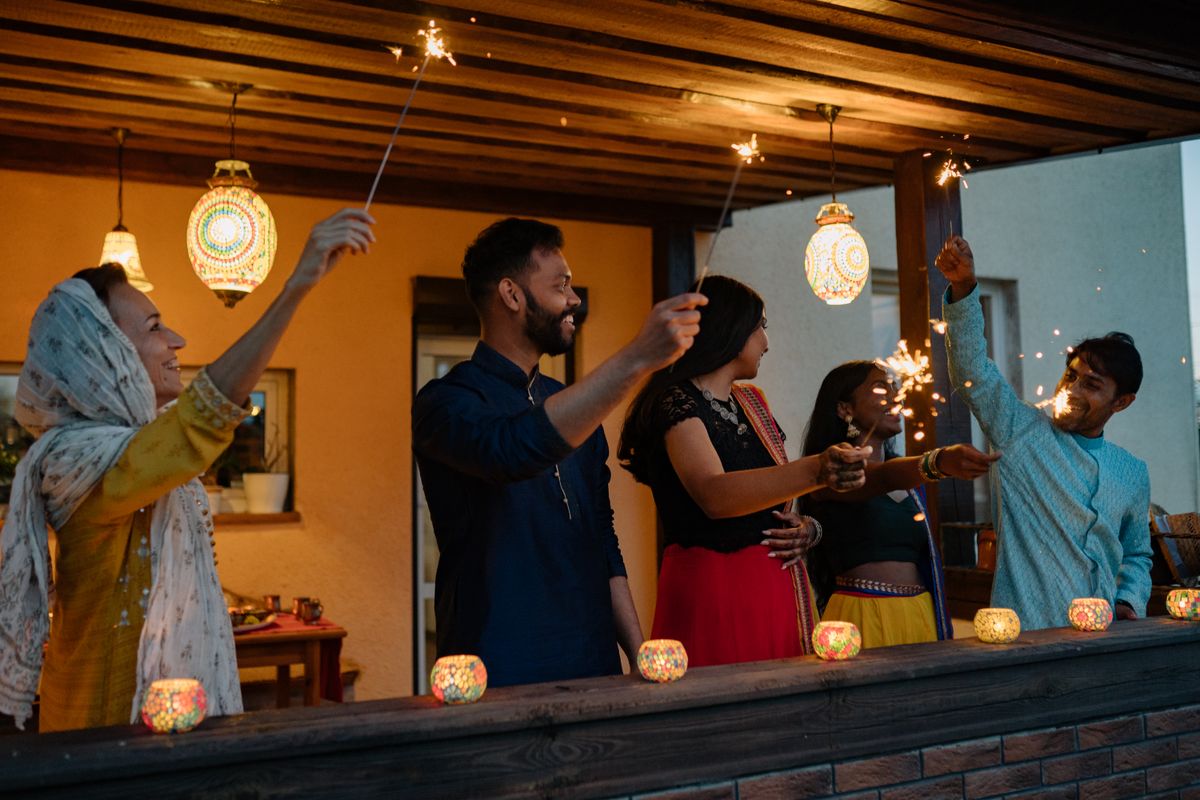
Hiring a community Diwali party DJ in Dallas is a different job from hiring one for a wedding reception or an office party. Nobody in the room needs the festival explained to them. The music does not have to introduce anything, the crowd already knows every song that matters, and half the guests will sing along whether or not they are on the dance floor. What makes these events hard is everything around the music: a puja that owns the first part of the evening, a hall with a volume limit and neighbours, a floor that runs from four-year-olds to grandparents, and a planning committee rather than one client.
This is deliberately not the workplace version of the event. If you are planning a Diwali celebration for a company, an ERG or a client-facing corporate audience, that has its own set of problems and we covered them separately in Corporate Diwali & Holiday Party DJ in Dallas. This post is about the community-run version: temple and community-hall celebrations, apartment and HOA society nights, and the large multi-family house parties that fill DFW living rooms and backyards every autumn.
The three kinds of community Diwali event in DFW
They look similar on an invitation and behave nothing alike once you are loading in.
The temple or community-hall celebration
Two hundred to six hundred people, a religious or cultural program in the first half, a catered or potluck dinner, and dancing afterwards if the hall allows it. There is almost always an existing sound system on the ceiling and a microphone already used for announcements. Your DJ is not replacing that system, they are working alongside it, and the two need to be sorted out before the doors open rather than during the aarti.
The apartment or HOA society night
Common in the newer complexes across Irving, Frisco, Plano and Richardson, where a large share of residents celebrate. The amenity room or pool deck is booked for a few hours, there is a hard end time in the reservation agreement, and there are residents upstairs who did not sign up for a party. This is the format most likely to be shut down early, and almost always because of volume rather than behaviour.
The large family Diwali party
Sixty to a hundred and fifty people in a house, a backyard, a clubhouse or a small banquet room. No formal program, but there is usually a short puja, a lot of food, kids everywhere, and an expectation that the music turns into real dancing at some point in the evening. The constraint here is space and power, not permits.
The puja comes first, and the running order has to respect it
At a wedding the DJ effectively owns the timeline. At a community Diwali event they do not. A Lakshmi puja, an aarti, a diya lighting, a priest or an elder speaking, and often a set of kids’ performances all come before anyone dances, and none of it moves for the music.
Two practical rules cover most of it. First, music is off during the puja and the aarti unless the organisers specifically ask for a recorded aarti track, in which case they should supply the exact recording their community uses. There are many versions of the same aarti, and playing the wrong one in a room of people who know it word for word is noticeable. Second, somebody has to decide who is on the microphone for the puja and how it is amplified, because a priest speaking into a house PA while the DJ system sits idle sounds like a technical failure to guests even when it is intentional.
The harder problem is the restart. After the puja and dinner, the room is seated, full and talking, and the dance floor is empty. That transition is the single most-missed moment at these events, and it is a music-and-microphone problem: a clear announcement, the lights adjusted, and an opening set aimed at the people most likely to get up first rather than at the people the DJ personally wants to play for.
Volume in a shared hall is the constraint nobody plans for
A wedding banquet hall in Dallas is built for amplified music. A temple hall, a community centre and an apartment amenity room are not. They have hard floors, low flat ceilings, glass, and often a neighbouring room or unit in use at the same time. The same system that sounds excellent in a carpeted ballroom becomes unintelligible in a bare hall long before it becomes loud.
Things worth settling with the venue in advance:
- Whether there is a written decibel limit or a staff member empowered to ask for a reduction, and who that person is on the night
- The hard end time for amplified music, which is frequently earlier than the end time for the event itself
- Whether an adjacent hall, classroom or unit is occupied during your slot
- Where the elders will be seated relative to the speakers, which is a bigger deal at a family festival than at a wedding
An experienced DJ handles a low ceiling by changing the deployment rather than the volume knob: speakers on stands aimed at the floor instead of the seats, the subwoofer kept away from a corner where it will boom, and the low end trimmed rather than the whole system turned down. Bass is what travels through a shared wall and what makes a hearing aid useless at a dinner table. Keeping the low end under control is usually what buys the extra hour of dancing.
An all-ages floor, from toddlers to grandparents
This is the real difference between a community Diwali party and every other event a Dallas DJ works. At a wedding reception the median guest is an adult who came to dance. At a Diwali celebration you have young children who will be on the floor at eight o’clock and asleep by ten, teenagers who will not dance until their friends do, parents managing both, and grandparents who came for the puja and the food and will leave before the late set.
The sequence that works runs oldest and youngest first, then narrows:
- Early evening: familiar, melodic, moderate-volume music under the arrival, the puja preparations and dinner. Older Bollywood, devotional-adjacent instrumentals and regional favourites belong here, not in the late set
- The garba and dandiya block: the one thing at which four generations will all be on the floor at the same time
- Bollywood and film music: the broad middle, once the children have thinned out
- Late set: bhangra, current Punjabi and Hindi tracks, and remixes for the crowd that is still there
A DFW community crowd is also not a single-language crowd. Depending on which families run the event you may need Gujarati garba, Punjabi folk, Tamil and Telugu film music, and Marathi or Bengali requests in the same evening. That is a briefing question, not a guessing game, and it is the difference between a floor that fills and one that watches. Reading which of those is actually working on the night is its own skill, and we broke it down in Bhangra, Bollywood, or Fusion?.
The dandiya block is not a Navratri night
Plenty of Diwali celebrations include a garba and dandiya set, and it is usually the highlight. But it is a set, not the format. A dedicated Navratri garba night is built end to end around the dance, with the tempo arc, the circle-management and the stamina of a crowd that came specifically for it. That is a different event and we planned it out in the Garba & Dandiya night guide. At a Diwali party, treat it as a thirty to forty-five minute feature with a defined start, announced clearly so people can collect their sticks, and an exit into general dancing rather than a dead stop.
Power, load-in and the existing house system
Community venues are where DJ setups actually fail, and the causes are dull and predictable. A temple hall or amenity room runs its outlets off shared circuits with a warming kitchen on the same breaker. A potluck means fifty people carrying dishes through the one door you also need for gear. Ceremonial lamps, decorations and a rangoli often sit exactly where a speaker stand needs to go, and nobody wants the DJ to be the reason they get moved.
The fixes are simple if they happen early: a load-in window before the food arrives rather than during it, a confirmed answer on which outlets are on which circuit, cable runs taped along walls rather than across the path from the kitchen, and an agreement about whether the house microphone or the DJ’s microphone is used for announcements. Two systems both running announcements at different volumes is a very common and entirely avoidable problem.
You are working with a committee, not a couple
Community events are organised by a group: a temple committee, an HOA social club, an association board or four families splitting the work. That is fine, but it needs one named person as the point of contact on the night, with the authority to say the program is running late and the dandiya set is moving. Without that, a DJ receives three contradictory instructions from three well-meaning organisers within the same ten minutes.
The other committee-driven element is the microphone program: welcome remarks, sponsor and donor acknowledgements, a raffle or fundraiser, and kids’ performances. Each of those has a cue and each needs a decision about who reads it. If there are dance performances by children or a cultural group, the same discipline applies as at a sangeet: one edited audio file per act, the exact rehearsed cut, named by act, sent days ahead rather than handed over on a phone that evening. We wrote that process out in detail in Sangeet Dance Performance Cues, and it transfers to a community stage without changes.
About the date
Diwali moves against the Gregorian calendar, and the exact dates depend on the panchang and on which tradition your community follows. Confirm the date against a panchang or your temple’s own calendar rather than any vendor’s website, including this one.
What matters for booking is that community Diwali events rarely land on the festival day itself. They cluster on the two or three weekends around it, which means every hall in Irving, Plano, Frisco, Carrollton and Allen and every experienced DJ in the metroplex is being asked for the same handful of dates. Committees that book the venue in summer and the entertainment a month later routinely find those weekends already gone. Lock the date first, then the DJ, and do it earlier than feels necessary.
What to send your DJ before the event
- The venue name, the load-in door, and the amplified-music end time from the reservation agreement
- Whether a house PA and microphone exist and whether the DJ may use them
- The program order: puja, aarti, speeches, performances, dinner, dancing, with rough times
- Which communities and languages are actually represented among the guests
- Any specific aarti or devotional recording the organisers want used
- Audio files for every performance, named by act, sent in advance
- One point of contact for the night, with a phone number
- Whether a dandiya block is wanted, and roughly when
Getting it right in Dallas
A good community Diwali party DJ in Dallas is measured by things guests never consciously notice: the puja was not interrupted, the elders could hear each other at dinner, the children got their half hour, the dandiya set filled the floor, and nobody from the front office came in to ask for the volume down. The music matters, but at a community celebration the running order and the room are what decide whether the evening works.
DJ Jazz Entertainment has been working South Asian celebrations across Dallas–Fort Worth for over 25 years, with DJs, MCs, live dhol, sound and lighting for weddings, corporate functions, cultural events and private parties throughout the metroplex and its suburbs.
