

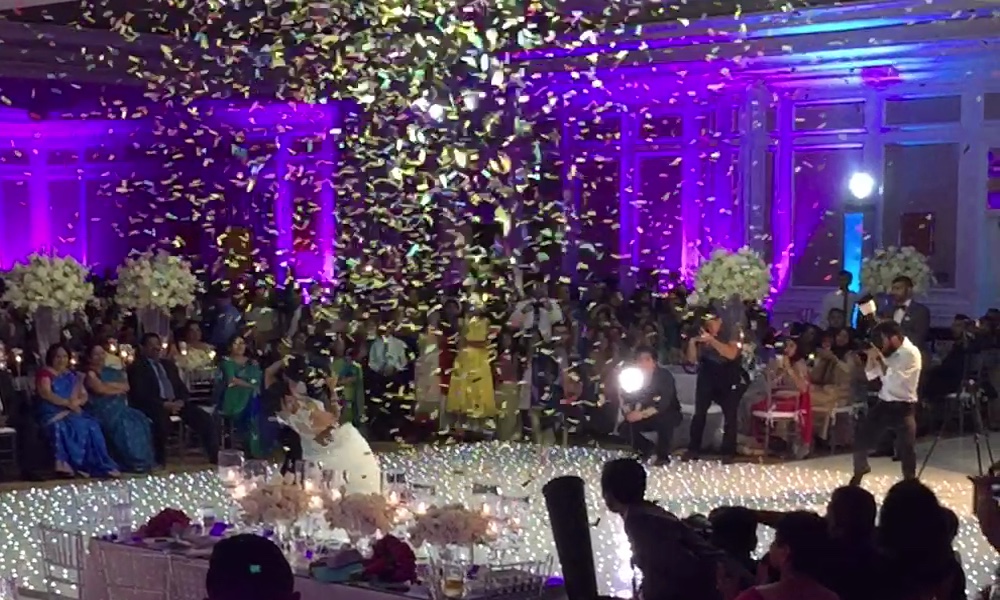
Most couples plan a Dallas wedding reception in terms of what happens: grand entrance, dinner, speeches, first dance, dancing. What almost nobody plans is who says each of those out loud, in what order, and what fills the ninety seconds between one moment and the next. That gap is where a reception quietly loses its energy — not during the big moments, but in the dead air around them.
This is the reception timeline from the booth’s side of the room: what a wedding DJ and MC actually announce across a South Asian reception in Dallas–Fort Worth, when each cue lands, and the decisions you need to make before the night starts. If you are still mapping out the whole wedding weekend rather than one evening, start with our South Asian wedding planning timeline for Dallas — this post picks up where that one leaves off, at the reception door.
A reception is a program with a soundtrack, not a party with interruptions
The single most useful reframe: for the first two to three hours, your DJ is running a program. Music is underneath it. Somewhere in the evening there is a handoff, and everything after that handoff is a dance floor with almost no talking.
Nearly every reception problem in Dallas banquet halls comes from one of two mistakes. Either the program half is unscripted, so the MC improvises and moments arrive late. Or the program never really ends, so someone takes the mic at 10:15 while eighty people are already dancing and the floor never recovers.
A good running order fixes both. Here is what one looks like.
Cocktail hour: the two announcements that matter
Cocktail hour feels like the part that runs itself. It does not. Guests are arriving from a ceremony that ran late, the couple is still with the photographer, and nobody knows where to go.
Your DJ should make exactly two announcements here, and no more. One near the start, telling guests where the bar and the seating chart are. One about ten minutes before doors open, telling people to finish their drinks and start moving toward the ballroom. That second one is worth more than it sounds — an entrance that starts with half the room still in the foyer is an entrance the couple only gets once.
Music during cocktail hour is background: instrumental Bollywood, light Punjabi, lounge, a little Sufi. Conversation volume. If people are shouting over it, it is too loud, and they will arrive at dinner already hoarse.
The grand entrance: the most-botched announcement of the night
The grand entrance is where a reception either starts hot or starts flat, and it is almost entirely a preparation problem rather than a skill problem. Four things decide it.
Who is being announced
Couple only, or the full wedding party first? A bridal party entrance of ten to fourteen people takes six or seven minutes and needs its own song. It also gives the couple a warmed-up room to walk into. Decide this in writing, not in the hallway.
The pronunciation list
Send your DJ every name being announced, spelled phonetically, in the exact order they walk. Not a guest list — a walking order. A name mangled on the mic in front of three hundred people is the one thing guests genuinely remember, and it is completely avoidable. If two cousins share a first name, note how each one should be introduced.
The song and the cut
An entrance song needs a hook that lands in the first fifteen seconds, because the walk is short. A DJ who knows the room will start the track at the drop rather than the intro. If you want a specific edit — a bhangra break under the couple’s entrance, a switch from a slow build into something loud — send the request early enough that it can be built and tested.
Where the walk ends
Straight to the sweetheart table, or straight onto the dance floor for a short entrance dance? Both work. But they are different cues, and the DJ needs to know which one, because one ends with music fading under an MC line and the other ends with a full track running its course.
Blessing, welcome, and the first course
Once the couple is seated, the MC hands off. Depending on the family, this is a short welcome from the bride’s father, a blessing, a prayer, or simply an invitation to eat. Two practical notes: whoever speaks needs the mic physically handed to them rather than pointed at, and buffet lines need to be released table by table or the room jams. Your DJ can call tables. It is unglamorous and it saves twenty minutes.
Dinner music is the most underrated decision of the night. Too loud and elders leave early. Too sleepy and the room flatlines. The right dinner set drifts upward in energy across the meal so the floor is already leaning forward when it opens.
Speeches: the timing decision that saves your night
Speeches are the most common reason a Dallas reception runs long, and the fix is structural rather than social.
- Cap the number. Four speakers is a program. Eight is an open mic, and the last three play to a room that has stopped listening.
- Split them. Two before dinner service, two after, rather than stacking forty minutes between the meal and the dancing. A room that sits through six speeches back to back does not get up afterward.
- Name the order in writing. Your DJ should know who follows whom, so the next speaker is already walking up as the previous one finishes.
- Count the mics. There are almost always more speakers than anyone told the DJ. If a slideshow or video is playing, the audio file goes to your DJ days ahead — not on a phone, not on a streaming link, in a banquet hall with unreliable Wi-Fi.
- Agree a cutoff. Someone — usually a sibling or the planner — needs authority to close the speech block. It should not be the couple, and it should not be the DJ improvising.
First dance, family dances, and the moments in between
The first dance is the pivot point of the evening. It is also the moment couples most often over-plan and under-time. A full song runs three and a half to four minutes, and dancing alone in front of three hundred people is longer than it sounds — many couples ask for an edited version of about two minutes, and that edit needs to exist before the wedding day, not be improvised at the booth.
After the first dance, the running order usually goes: a parent dance or two, then any family or friend performances, then the floor opens. Performances at a reception follow the same rules as a sangeet showcase — one edited audio file per act, act-named, sent ahead, with a named person cueing the start. We covered that discipline in detail in our post on sangeet dance performance cues, and it applies identically here.
The South Asian reception has its own moments — name them
Reception templates written for Western weddings assume a cake cutting and a bouquet toss. Many South Asian receptions in DFW have neither, and have several moments those templates never mention. Every one of them is an announcement your DJ needs on the running order:
- A reception varmala or garland exchange, when the ceremony version was private or the reception is the main public event
- Aashirwad or a formal blessing sequence, where elders come forward in a specific order
- Mithai or a cake cutting, or both, or neither
- Games carried over from the ceremony day — joota chupai settlements, doodh pilai — which are funny in person and confusing over a PA unless the MC sets them up in one sentence
- A gift or envelope receiving line, which quietly eats thirty minutes if it is not scheduled
- A late-night dhol feature, if you have one booked for the reception rather than the baraat
None of these are optional extras to slot in wherever. Each has an ideal position, and a DJ who has run South Asian receptions in Plano, Frisco and Irving will have an opinion about where each one belongs. Ask for it.
Opening the floor: the handoff
There should be one clear moment where the program ends and the night becomes a dance floor. The MC says one short line — not a speech — and the first real track drops. From that point, announcements essentially stop.
The first fifteen minutes of open dancing decide the rest of the night. Most experienced DJs open with something that gets the widest possible age range up: recognisable Punjabi or Bollywood the aunties and uncles know, before the floor narrows to the couple’s own generation and, later, the cousins. How that progression is read in real time is a whole craft of its own, and we broke it down in bhangra, Bollywood, or fusion.
Last call, last song, and the part nobody plans
Your venue contract has a music end time in it. It is usually earlier than the event end time, because load-out has to finish before the hall closes. Confirm both numbers with your venue directly rather than assuming, and make sure your DJ has them in writing.
Working backward from that end time, a good running order has a last-call announcement roughly twenty minutes out, then a deliberate final track. Some families finish with a big group song, some with a slow closing number for the couple, some with a farewell as the couple leaves. Decide which one you want. A reception that simply stops because the clock ran out is the difference between guests leaving on a high and guests drifting toward the parking lot.
What your DJ needs, two weeks out
Almost everything above comes down to one document. Two weeks before the wedding, your DJ should have:
- A running order with approximate times and the sequence of every named moment
- The entrance walking order with phonetic spellings
- Song selections for entrance, first dance, parent dances, and any performance
- Every custom audio and video file, delivered as actual files
- The speaker list in order, and who has authority to close the speech block
- One named night-of contact who is not the couple
- The venue’s music end time and load-out window
That last item matters more than couples expect. On the night, you will be photographed, greeted and pulled in six directions. Somebody else needs to be answering the DJ’s questions, and everyone should know in advance who that is. Vetting for exactly this kind of coordination is part of what to cover before you book — see what to ask a Dallas wedding DJ before you sign.
The short version
A Dallas wedding reception timeline is not a list of things that will happen. It is a sequence of cues, each with a person attached, a piece of audio ready, and a clear idea of what fills the gap before the next one. Get the running order written down and the reception runs itself. Leave it in everyone’s head and the night is spent recovering from the last transition.
DJ Jazz Entertainment has run South Asian weddings, corporate events and private celebrations across Dallas–Fort Worth for more than 25 years, providing DJs, MCs, dhol, sound and lighting throughout the DFW suburbs. If you are building a reception running order and want to talk through the sequence, we are happy to help.
