

Somewhere between booking the venue and finalising the guest list, most couples planning a wedding in Dallas hit the same fork: hire a live band, hire a DJ, or put both on the floor. It usually arrives sounding like a taste question. One of you grew up watching a band play a reception; the other has been to a hundred weddings where the DJ carried the entire night.
It is not really a taste question. It is a question about what happens in the room at 10:40 pm, how much stage you have to give up, and whether the music can turn on a request from the groom’s uncle. This guide lays out what each setup genuinely does well at a Dallas–Fort Worth wedding, where each one breaks, and why the hybrid — a DJ with live dhol or tabla layered on top — has quietly become the default at most South Asian weddings across DFW.
What a live band actually gives you
A band gives you a show. There are people on a stage, playing instruments, visibly reacting to the room, and for cocktail hour and dinner service that is hard to beat. Guests look up. The music reads as an event rather than a playlist. If your family has a strong association with live performance — a ghazal singer during dinner, a live Bollywood ensemble, a folk act with vocals over the dhol — a band delivers something a speaker cannot imitate.
Where a band gets constrained is repertoire and turning radius. A band plays what it has rehearsed. An ensemble that is excellent at Punjabi folk and nineties Bollywood will not have last year’s Telugu hit, or the Afrobeats track your cousins have been waiting all night for. Requests outside the book get a polite no, and the wider your guest list spreads across languages and generations, the more often that happens.
Bands also take breaks. A four-hour reception is not four hours of continuous live music — it is sets with gaps between them, and somebody has to fill those gaps. At a lot of weddings that somebody is a laptop on a side table with nobody watching it, which is exactly when a full dance floor quietly empties.
What a DJ actually gives you
A DJ gives you the entire catalogue and the ability to change direction in eight seconds. That matters more at a South Asian wedding than at almost any other kind of event, because the floor you are trying to hold contains three generations and often three or four languages. The aunties want the song they danced to in 1998. The couple’s friends want what is on the radio now. The Telugu side of the family and the Punjabi side of the family both need to feel like the night was partly theirs.
Only a DJ can serve that in real time, reading which section of the room is standing up and adjusting the next track accordingly. We wrote about how that reading actually works in Bhangra, Bollywood, or Fusion? Reading the Dance Floor at a Dallas Indian Wedding — the short version is that the skill is not the playlist, it is the willingness to abandon the playlist.
A DJ also runs the room’s announcements. At most weddings the same person handling music is handling the grand entrance, the table-by-table dinner release, the speeches and the last call. A band does not do that job, so a band-only reception still needs an MC, which is a second booking and a second person to coordinate.
The honest weakness of a DJ-only setup is spectacle. Two speakers and a booth do not give guests anything to watch. That is a real gap during the parts of the evening when nobody is dancing yet.
Why the hybrid is the default at DFW South Asian weddings
The setup most couples in Dallas, Plano, Frisco and Irving actually end up with is neither of the above in its pure form. It is a DJ running the night with live percussion brought in for specific, high-impact moments — almost always dhol, sometimes tabla, occasionally a vocalist for one segment.
The logic is straightforward. Live dhol over a DJ track is the loudest, most physical moment of the entire wedding, and it does not require the DJ to give up control of the catalogue for the rest of the night. The baraat is the obvious placement; a late-evening dhol feature during the reception is the other one that consistently works. If the dhol side of this is what you are weighing, our full guide to hiring a dhol player for a Dallas wedding covers the procession in detail and is the better read for that specific decision.
The hybrid also solves the break problem in the opposite direction from a band. The live element is scheduled in short, deliberate features, and the DJ covers everything on either side of it. There is no gap, because the gap was never structural.
The four things that actually decide it
Song coverage and request flexibility
Ask any band for its actual song list before you book, not a genre description. Then hold it up against your guest list. If your families span Punjabi, Gujarati, Telugu, Tamil, Urdu and Hindi repertoire plus Western Top 40, a single band will cover part of that and a DJ will cover all of it. If your guest list is narrower and the band’s book matches it closely, the calculus changes.
Cost structure, not just cost
The useful distinction is not which is cheaper — it is that they scale differently. A band’s cost moves with headcount: every additional musician is another person, another meal, another input on the stage. A DJ’s cost moves with equipment and hours: more sound coverage, more lighting, more events across the weekend. A hybrid sits in between, because you are adding one or two performers to a DJ setup rather than an entire ensemble.
That means the two options respond to a budget adjustment in different places. Trimming a band usually means fewer musicians and a thinner sound. Trimming a DJ package usually means less lighting or fewer hours. Ask any vendor to quote your specific event rather than reading a package page, and get the number of people and the number of hours written down.
Stage footprint, power and load-in
This is the constraint couples underestimate most. A band needs stage area, chairs, monitors, more microphones and considerably more power than a DJ setup. In a hotel ballroom that usually just means a smaller dance floor. In a banquet hall with a fixed stage already holding a mandap or a sweetheart table, it can mean the band and the head table are competing for the same square footage.
Every venue handles power, load-in timing and stage access differently, so confirm those specifics with your venue directly rather than assuming — and get your entertainment vendor talking to the venue before the contract is signed, not the week of.
Breaks and dead air
Ask a band directly: how many sets, how long, and what plays in between? If the answer is a phone on shuffle, you have found the weak point of the evening. Ask a DJ the mirror-image question: what happens during dinner, and is anything live scheduled at all? Neither answer disqualifies a vendor. Not having an answer does.
Matching the setup to the function
A multi-day South Asian wedding weekend does not need one answer — it needs one per event.
Baraat. Live dhol, essentially always. This is the single moment where live percussion is not a nice addition but the actual point.
Sangeet. DJ-led. The evening is built around family dance performances that run to specific edited tracks and specific cues, which is a DJ’s job rather than a band’s.
Ceremony. Neither, mostly. The ceremony is priest-led and often has its own live musicians. The audio job here is amplification and restraint, not entertainment.
Cocktail hour and dinner. The strongest case for live music in the whole weekend. A small live act here earns its place, and it costs you nothing on the dance floor because the dance floor has not opened yet.
Reception dancing. DJ-led, with a live dhol feature dropped in once the floor is already full. Reversing that order — live act first, DJ afterwards — means rebuilding the room’s energy twice.
Questions to settle before you book either one
- Who is the actual named performer or DJ, and is that name written into the contract?
- If it is a band, what is the complete song list, and what happens between sets?
- If it is a hybrid, who is responsible for the live musicians — the DJ company or you?
- Who is making announcements, and is that person included or a separate booking?
- What is the total stage and floor footprint, and has the venue confirmed it fits?
- How many microphones are included, and who owns them during speeches?
- What is the backup plan if a piece of equipment fails mid-reception?
That last set overlaps heavily with the vetting we cover in What to Ask a Dallas Wedding DJ Before You Sign, and the same questions are worth asking a band with the wording adjusted.
So which one should you book?
If your guest list is culturally and generationally wide — which describes most South Asian weddings in DFW — a DJ should run the night, because nothing else can serve that many musical expectations in real time. Add live dhol for the baraat and one reception feature, and add a live act during cocktail hour or dinner if the budget allows and the stage has room.
Book a band as the primary entertainment when your family’s musical centre of gravity is genuinely live performance, your guest list is concentrated enough that one book covers it, and you have both the stage footprint and a separate plan for announcements and set breaks.
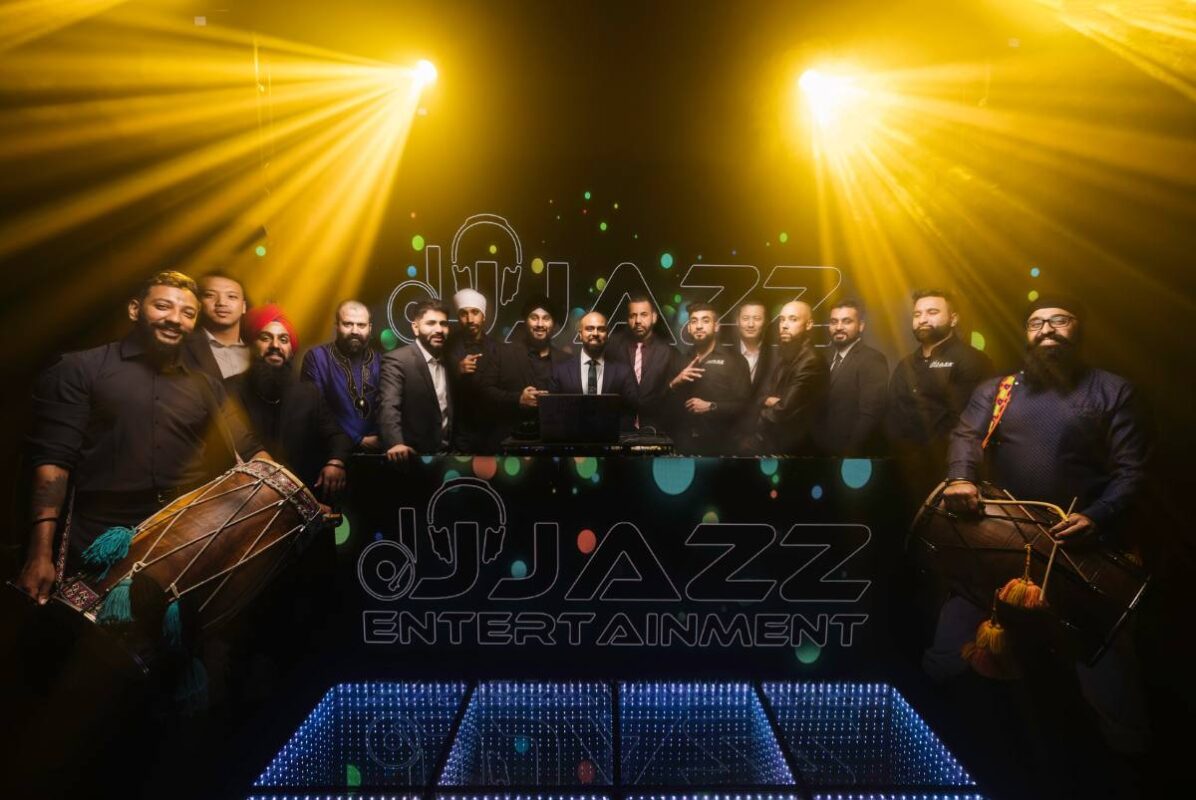
What matters more than the category is that whoever is running the room has done a wedding shaped like yours before. DJ Jazz Entertainment has been working weddings, corporate events and cultural celebrations across Dallas–Fort Worth for over 25 years, with DJs, MCs, live dhol, sound and lighting under one roof — which is usually the simplest way to make the hybrid work without coordinating three vendors yourself.
