

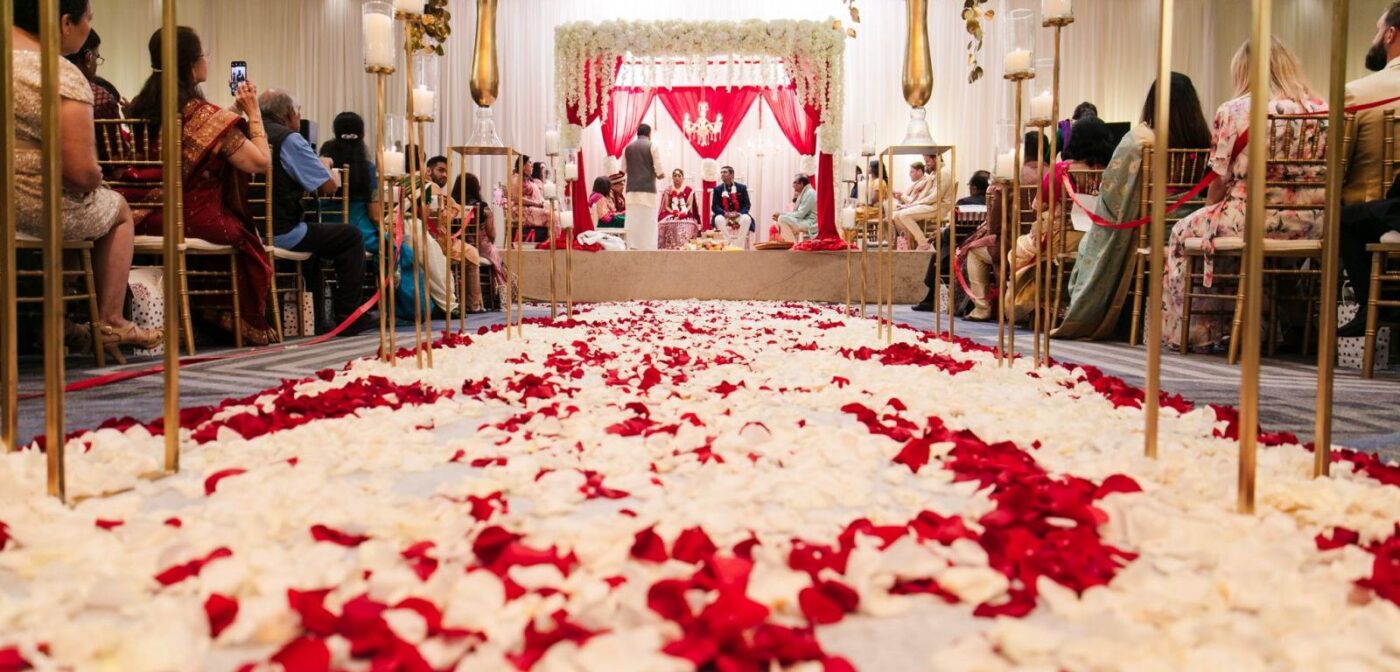
An outdoor mandap is one of the most beautiful things a Dallas–Fort Worth wedding can do. Open sky above the four pillars, a garden or a lawn or a hotel terrace instead of a ballroom ceiling, natural light for every photograph of the pheras. It is also, in this part of Texas, a plan that has to come with a second plan attached.
North Texas does not do gentle weather. A May afternoon can go from clear to a severe thunderstorm warning in under an hour. A July ceremony scheduled for two in the afternoon can sit in triple-digit heat with no shade. Spring and fall bring wind that will lift an unweighted mandap panel and put a microphone into a constant roar. None of this makes an outdoor mandap a bad idea. It makes an outdoor mandap a two-plan idea.
This is the contingency layer — how to build a backup plan for an outdoor ceremony in DFW that is real rather than theoretical, who decides when to use it, and what your DJ and sound team need from you so that moving the ceremony does not mean losing thirty minutes and the audio with it.
The four things DFW weather actually does to an outdoor ceremony
Planning gets easier when you stop treating "bad weather" as one problem. It is four different problems with four different responses.
Heat
From roughly June through September, afternoon highs across Dallas, Plano, Frisco and Irving sit in the high nineties and above, and the humidity makes the felt temperature higher still. An outdoor ceremony in that window is a guest-welfare question first: elders in heavy silk, a bride in a lehenga, a groom in a sherwani, a priest sitting on an unshaded platform beside a live havan fire. Heat is also the most predictable of the four, which means it is the one you can design around instead of react to.
Rain
Spring is the wet season here and pop-up storms are common well into early summer. Rain rarely lasts the whole afternoon in DFW — the harder problem is that it arrives fast, soaks everything in twenty minutes, and leaves you with a waterlogged lawn and a ceremony still to run.
Wind
The most underestimated of the four. Wind does not cancel a ceremony, so nobody plans for it, and then it ruins the audio and the décor simultaneously. It lifts drapery, tips floral arrangements, blows out the havan flame, scatters loose ceremony items, and puts a low rumble under every word the pandit says. Any open-air ceremony needs weighted structures and wind protection on microphones as a default, not as a response.
Ground conditions
Separate from the rain itself. A lawn that took an inch of water overnight is a different surface the next day, even under blue sky — soft ground for chair legs and mandap poles, and a genuine safety issue anywhere power cable crosses a walkway.
Build the backup as a real venue, not a vague intention
The single most common failure is a backup plan that exists only as a sentence: "if it rains we will move inside." Inside where, holding how many people, set up by whom, and with what mandap?
A backup plan that will actually work has all of these settled in writing before the week of the wedding:
- A specific named room that seats your actual guest count, not your optimistic one.
- Who moves the mandap, and whether your florist or décor vendor has priced a second setup or a relocation into their contract. This is the item most often missed, and it is not a small job — a mandap is a built structure.
- How long the move takes, as a number your vendors agree on, because that number is what your call time is built from.
- What happens to the chairs, the aisle and the floral if they are already set outdoors when the call is made.
- Whether the backup room is already committed to another function that day. A hotel with three ballrooms is not the same as a hotel with three available ballrooms.
Ask about all of this directly — policies, room availability and setup responsibilities vary by property, and the only reliable answer is the one you confirm with your venue and each vendor in writing. It belongs in the same conversation as the other operational questions covered in our guide to what to ask a DFW venue before you book.
The call: who decides, and when
Weather decisions go badly when nobody owns them. On the morning of the wedding there are two families, a planner, a photographer, a florist, a caterer and a DJ all forming opinions, and a bride who should not be the person adjudicating a radar image.
Decide three things in advance:
One named decision-maker. Usually the planner or coordinator; if there is no planner, one designated family member who is not the bride or groom. Everyone else advises. That person calls it.
A deadline, tied to setup time. If the move takes ninety minutes, the call happens no later than ninety minutes before it needs to be done — not when the first drops land. Working backward from the ceremony start is the only version of this that functions.
What triggers it. Not "if it looks bad", but something concrete: a specific probability threshold on the forecast at the call time, an active severe-weather warning for the county, or a heat index over a number the family agrees on. A written trigger prevents the twenty-minute argument that eats the buffer.
Also worth deciding in advance: whether a partial move is on the table. Many DFW couples end up with the ceremony indoors and the reception outdoors as planned, or vice versa. If that hybrid is acceptable, say so early, because it changes what the vendors stage where.
Heat: the guests, the priest, and the equipment
Heat is the one you can genuinely design out of the problem, mostly by moving the clock rather than the location.
Time of day does more than anything else. A summer ceremony at four or five in the afternoon is a meaningfully different event than the same ceremony at one. Where a muhurat is fixed and cannot move, everything else has to absorb the heat instead — shade structures over the guest seating, not only over the mandap; water stations that are visible and staffed; a shaded holding area for the bridal party; and a realistic ceremony length, because a ninety-minute ceremony in full sun is a different ask than a forty-minute one.
The havan fire compounds it. An open flame in the middle of an already-hot afternoon affects the couple, the priest and the front rows more than people expect. Ventilation and a shade canopy over the mandap matter for that reason as much as for the sun.
Equipment has heat limits too. Speakers, amplifiers, laptops and battery packs sitting in direct Texas sun will throttle or shut down, and a laptop that goes into thermal protection mid-ceremony is a silence you cannot fix quickly. Any competent outdoor setup keeps the gear shaded and ventilated, which means the booth or equipment position needs shade allocated to it in the layout — a genuine planning item, not something to sort out on the day.
Rain and wind: what a tent solves and what it does not
A tent is a good answer to rain and a partial answer to heat. It is not an answer to wind, and it is not automatically an answer to power or to sound.
What a tent genuinely fixes: dry guests, dry gear, shade, and a ceremony that proceeds through a passing shower. What it does not fix on its own:
- Rain noise. Heavy rain on a tent roof is loud, and it lands directly on top of the quietest part of the day. A ceremony that was going to be lightly amplified may need more support than planned.
- Wind. Sidewalls, weighting and staking are separate decisions from the tent itself, and an unweighted mandap inside a tent is still an unweighted mandap.
- Standing water and mud underfoot, which is a cable-routing and safety problem regardless of what is overhead.
- Temperature. A closed tent in August without climate control is hotter than the lawn, not cooler.
If a tent is the plan, confirm with the rental company and the venue what is included — sidewalls, flooring, lighting, weighting method, and whether power is run to it — rather than assuming any of them come with the canopy.
Power and cable safety on wet ground
This is the part of an outdoor ceremony most likely to become an actual hazard rather than an inconvenience, and it is worth stating plainly.
Outdoor ceremony sites frequently have no usable power near where the ceremony happens. That leaves three options, and they need to be settled with the venue in advance: a real distribution point within reach, a generator positioned far enough away that guests do not hear it, or a fully battery-powered setup sized for the length of the ceremony. Extension cords daisy-chained from a building fifty yards away is not a fourth option.
Wherever the power comes from, wet ground raises the stakes on every connection. Elevated and covered connection points, weather-rated cable, proper matting or taping wherever cable crosses a path guests walk on in formal footwear, and a plan for what happens if the ground is soaked before the ceremony even begins — those are the basics, and they are worth confirming your vendors are handling rather than assuming.
The same applies to anything with a battery. Heat shortens battery life; so does a device that has been sitting in a hot car since morning.
What your DJ specifically needs from the backup plan
Sound is usually the last thing anyone thinks about in a weather move and the first thing guests notice when it goes wrong. Four things make the difference:
Include the DJ in the call. Not as the decision-maker, but as someone who is told the moment the decision is made. Audio equipment takes real time to strike and re-set, and finding out at the same moment as the guests means being the last vendor ready.
Know whether the backup room needs a different setup. A ballroom is not a lawn. Speaker placement, coverage and volume all change indoors, and a room with hard surfaces behaves very differently from open air. If the backup room is known in advance, it can be planned for in advance.
Two positions, one plan. The best outdoor ceremonies have both locations mapped before the day — where equipment sits outside, where it sits inside, and what the move between them actually involves.
Protect the ceremony audio from wind before you need to. Wind protection on outdoor microphones costs nothing and should be standard for any open-air ceremony, particularly one with a pandit who moves, live shehnai or nadaswaram players, or vows spoken quietly.
These are the kinds of specifics worth raising during vendor selection rather than the week of the wedding — several of them belong on the list in our guide to what to ask a Dallas wedding DJ before you sign.
Season by season in DFW
March to May. The most beautiful outdoor window and the most volatile. Comfortable temperatures, and the peak of storm season. A tent or a hard indoor backup is not optional in spring.
June to September. Heat is the governing constraint and rain is less likely. Late-afternoon or evening ceremonies, real shade, and honest expectations about ceremony length.
October to November. Often the best outdoor conditions of the year in North Texas — mild, drier, and long golden light for photographs. Wind is the main variable, and evening temperatures drop faster than people expect once the sun is down.
December to February. Genuinely mild days exist, but so do cold snaps and the occasional ice event. An outdoor ceremony here needs a heating plan and a low tolerance for optimism.
Put the weather plan in the timeline
The last step is to write the contingency into the day’s running order rather than keeping it in a separate conversation. The call time, the move window, the revised ceremony start if the move happens, and the knock-on effect on everything after it — cocktail hour, the reception program, the venue’s amplified-music cutoff, which does not move just because your ceremony did.
That single addition is what turns a weather plan from an idea into something the whole vendor team can execute at eleven in the morning without a meeting. It sits naturally alongside the broader planning sequence in our South Asian wedding planning timeline for Dallas, and it feeds directly into the reception running order covered in what your DJ actually announces, and when.
DJ Jazz Entertainment has spent 25+ years working weddings, corporate events and cultural celebrations across Dallas–Fort Worth — DJs, MCs, live dhol, sound and lighting — including plenty of ceremonies where the plan changed at ten in the morning. An outdoor mandap in DFW is absolutely worth doing. It is worth doing with the second plan already written down.
