

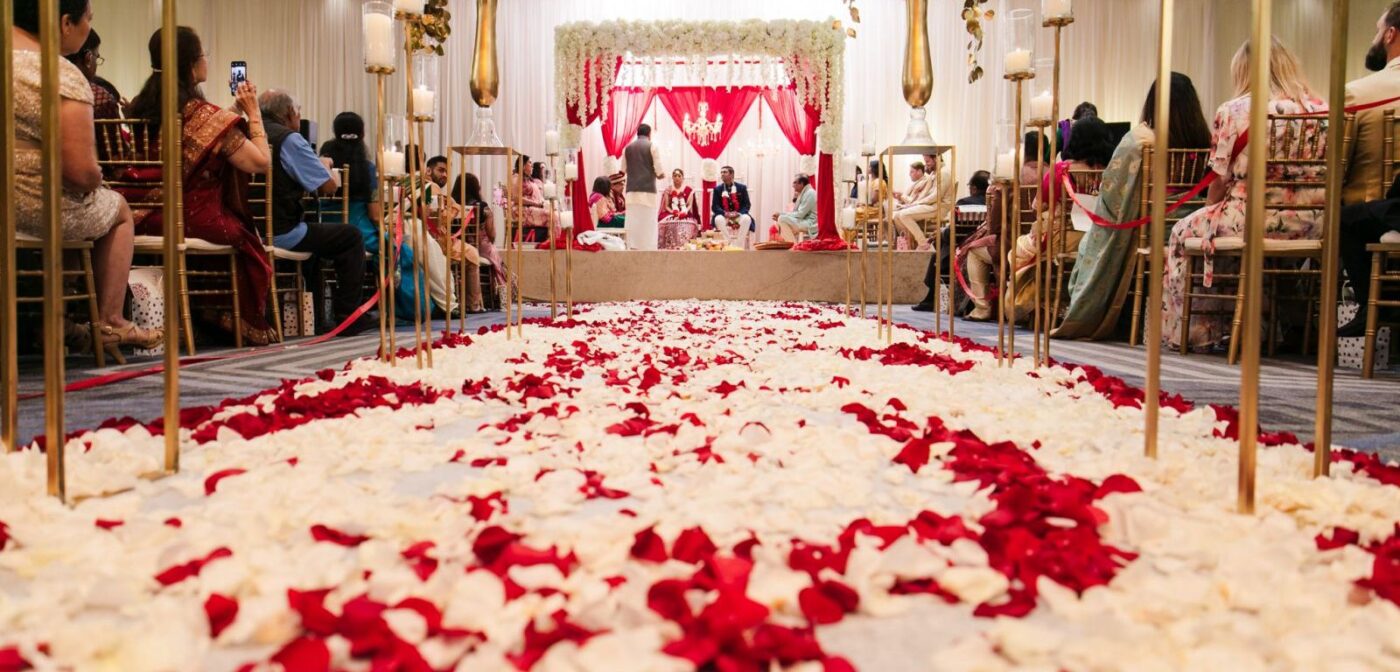
A winter wedding in Dallas–Fort Worth is not a summer wedding with jackets. When a South Asian family plans a November–February wedding in DFW, the baraat, the photos, the guest list and the vendor calendar all behave differently, and most of those differences show up in the run of show rather than the decor. This guide is planning advice for couples and families looking at a winter wedding in DFW: what moves indoors, what changes for the baraat, how short days reshape the photo schedule, and what happens when a large share of your guests are flying in from India, the UK, Canada or the Gulf.
It is written as a checklist of decisions, not a forecast. We will not tell you which weekends are “peak” or quote numbers about the season — your muhurat, your family’s travel window and your venue’s calendar decide that, and none of them are things a vendor’s blog can know for you.
Why a Winter Wedding in DFW Is Its Own Planning Problem
North Texas winters are mild most days and unpredictable on the rest. A sunny, comfortable Saturday is common; so is a cold front that drops the temperature sharply overnight, brings wind, or — less often — ice. You cannot plan for the average day, because the wedding is one specific day. The practical answer is to plan every outdoor element with an indoor version already decided, so nobody is making that call on the morning of.
The second difference is daylight. Winter evenings in Dallas get dark early, and a schedule copied from a summer wedding timeline will put your portraits, your baraat or your vidaai in the dark. Look up the actual sunset time for your date before you lock anything else.
The third is people. Winter is when many families in the diaspora can travel, so a winter wedding often carries more out-of-town and overseas guests than a spring one. That changes how many events you run, when they start and how the welcome is handled.
Everything Moves Indoors — Plan the Room, Not Just the Venue
For most winter weddings in DFW, the ceremony, the sangeet and the reception all happen indoors. That sounds simpler, but an indoor wedding asks more of the room:
- Ceremony and reception in the same space. Many indoor weddings use one ballroom for the mandap and then “flip” it for the reception. A flip needs time and a holding area for guests. Ask your venue how long their flip takes and where cocktail hour goes while it happens.
- Sound in a closed room. A mandap indoors means the priest, the couple and the family are speaking to a seated room that can hear everything — including a DJ setting up at the back. Ceremony audio needs to be separate, quiet and tested. Our guide to wedding ceremony audio and mics for the priest and vows covers that setup in detail.
- Load-in through a building. Indoor events share loading docks, elevators and service corridors with other events in the same hotel or hall. On a busy winter Saturday, ask for a load-in window in writing.
- Dance floor size. When nobody can spill outside to a patio, the dance floor carries the whole crowd. If your guest count grew because family is flying in, confirm the floor size grew with it.
If any part of your plan is still outdoors — an outdoor mandap, a garden cocktail hour, an outdoor sangeet tent — treat the indoor backup as the real plan and the outdoor version as the upgrade. We wrote a full guide on rain and weather backup plans for an outdoor mandap in DFW; the same decision points apply in winter, with cold and wind replacing heat.
The Cold-Weather Baraat
The baraat is the part of a winter wedding that changes most. A summer baraat fights heat; a winter baraat fights wind, cold hands and a short window of daylight. A few things to decide early:
Decide the route length before the day
A long outdoor procession that feels festive in October can feel punishing on a cold, windy morning, especially for elders and young children. Agree on a shorter route as the default, and decide in advance who can call a further cut on the day. If the venue has a covered entrance, porte-cochère or large lobby, ask whether the final stretch can happen there.
Have an indoor baraat ready
Some venues will allow the procession to finish inside, in a lobby or pre-function area, with the milni at the ballroom doors. Whether that is allowed — and whether a dhol and a portable sound system are allowed indoors — is a venue rule, so confirm it with your venue directly, in writing. For more on what to ask, see which DFW wedding venues allow a full baraat.
Equipment and performers in the cold
Wireless microphones and portable speakers run fine in cold weather, but batteries drain faster, so spares should be in a pocket, not a van. Dhol players and live musicians need somewhere warm to wait until the procession starts, and a few minutes to warm up their hands and instruments. If there is a horse, a car or a decorated cart, ask that vendor what their cold-weather and wind policy is. Our dhol player and baraat guide covers the rest of the procession setup.
Short Days: Reworking Your Photo and Event Timeline
Photographers plan around light, and winter takes light away early. That has knock-on effects on the whole day:
- Move outdoor portraits earlier. If you want natural-light photos outside, they usually have to happen before or right after the ceremony, not after cocktail hour. Ask your photographer to work backward from the sunset time for your date.
- Consider a first look. Some couples who would not otherwise do a first look choose one in winter so portraits can happen in daylight.
- Plan the vidaai for the dark. If the vidaai or rukhsati happens after sunset, make sure the exit area is lit and the music or announcement for that moment is planned, because it will be cold and people will want to move quickly.
- Front-load the program. When the evening starts earlier in the dark, guests settle in earlier too. The reception timeline — entrances, speeches, first dance, cake — can often start sooner, which leaves a longer open dance floor. Our guide to the wedding reception timeline and what the DJ announces walks through that order.
Guests Flying In From Abroad
When a meaningful share of your guest list is travelling internationally, a winter wedding in DFW becomes a hospitality event as much as a wedding. That affects entertainment more than people expect.
The events multiply
Family who have flown in for a week will not want to see only the wedding. Welcome dinners, a mehendi, a sangeet, a haldi, the wedding, the reception and sometimes a post-wedding brunch can all land on the calendar. Each one needs its own sound plan, and some may need their own DJ or crew if they overlap. Our three-day wedding weekend guide covers how many DJs, how much gear and who moves it between events.
Jet lag shapes the first night
Guests who landed that morning do not dance until midnight. Put the high-energy event later in the week and keep the first gathering shorter, warmer and conversation-led. Elders who travelled the furthest should be able to leave early without missing the important moments.
Music for a mixed room
An international guest list brings different musical memories. Relatives from India may expect current Bollywood and Punjabi hits, cousins from the UK may expect bhangra and UK desi tracks, and friends from the US may expect a hip-hop and pop block. Give your DJ a written brief of who is coming and where they are from, and agree on the songs that matter for the family — and the ones to avoid.
Booking Pressure: Why Winter Dates Need Earlier Decisions
A winter date is usually chosen around a muhurat and around when family abroad can travel, which often means the date is fixed before anything else. Once the date is fixed, the vendors you want either have it open or they do not. That is the real booking pressure — not a statistic, just the fact that your date is not flexible.
Practical steps:
- Lock the venue and the DJ/MC early, because those two control most of the run of show.
- Confirm in the contract which DJ is assigned to your event, not just the company name.
- Ask what happens if severe weather closes roads or the venue — postponement terms, rescheduling and what the deposit covers.
- Share the full list of events (welcome dinner through reception) at the first conversation, so the vendor quotes all of it and holds the right crew.
For a fuller look at timing, read how far in advance to book a wedding DJ in Dallas, and for the questions worth asking before you sign, see what to ask a Dallas wedding DJ before you sign.
Winter Wedding Checklist for DFW Families
- Look up the sunset time for your wedding date and build the photo timeline from it.
- Decide the indoor version of every outdoor element now, and who makes the call on the day.
- Confirm in writing whether the baraat can finish indoors, and whether dhol and amplified sound are allowed there.
- Agree a shorter default baraat route and a warm waiting area for musicians and elders.
- Ask your venue how long a ceremony-to-reception flip takes and where guests wait.
- Give the DJ a guest-origin brief and a must-play and do-not-play list.
- Map every event in the wedding week and confirm sound and crew for each.
- Read the weather and postponement terms in every vendor contract.
Planning a Winter Wedding in Dallas–Fort Worth
A winter South Asian wedding in DFW can be the warmest event of the year — everyone indoors, family in from abroad, a full dance floor — as long as the cold, the dark and the travel are planned for rather than discovered on the day. DJ Jazz Entertainment has spent more than 25 years providing DJs, MCs, dhol players, sound and lighting for weddings, sangeets, receptions and cultural events across Dallas, Plano, Frisco, Irving and the rest of DFW. If your winter wedding date is set, check our availability and tell us about every event in your wedding week.
