

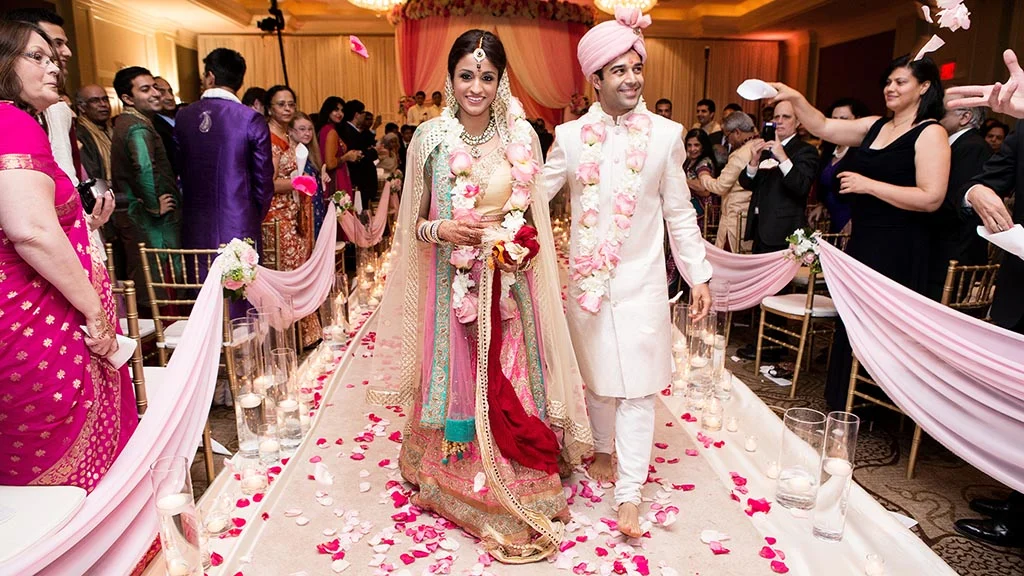
At most South Asian weddings in Dallas, the reception gets months of planning attention and the ceremony gets a microphone someone clipped on five minutes before the muhurtham. Then the video comes back and half the mantras are wind, rustle or silence, and the guests in the back rows spent an hour watching a ceremony they could not hear. Wedding ceremony audio is the least glamorous line on the entertainment plan, and it is the one families most often wish they had thought about sooner.
This guide covers the audio layer only: which microphone suits a priest who moves, how to make the vows audible without turning them into an announcement, how live musicians fit alongside speech, what changes on an outdoor mandap in DFW, and why a livestream for family overseas needs its own feed. Two related questions live elsewhere. If you are planning for rain, heat or wind as a contingency, start with Rain and Heat Backup Plans for an Outdoor Mandap Ceremony in DFW. And the principle that the ceremony belongs to the priest and the family, not the DJ, is set out in our Shashtiabdapoorthi planning guide and our Telugu and Tamil wedding guide, so it is not repeated at length here.
Why Wedding Ceremony Audio Fails in Dallas
Ceremony sound rarely fails dramatically. It fails quietly, in four predictable ways:
- The wrong microphone for the person. A handheld mic given to a priest whose hands are busy with ghee, rice and flowers ends up resting on the floor of the mandap.
- Clothing noise. A lapel mic clipped under a silk shawl or angavastram records every movement as a rustle louder than the voice.
- Speakers turned up instead of placed well. Loud front speakers make the first rows uncomfortable and still do not reach the back of a long ballroom or lawn.
- Nobody tested it with the actual people. The sound person checks the mic, the priest arrives at the last minute, and the first real level check happens during the opening puja.
None of those is a gear problem. Each one is a decision that was never assigned to anyone.
Choosing Ceremony Microphones for the Priest
The pandit, purohit or officiant is the voice the whole ceremony depends on, and the hardest one to capture: seated or standing, turning toward the fire, leaning to hand items to the couple, reading from a book, and often speaking or chanting for well over an hour. There are four realistic options.
Lapel (lavalier) microphone
The most common choice, and usually the right one. It leaves the priest’s hands free and follows his head as it turns. The details decide whether it works: clip it on the outermost layer at mid-chest, not under a shawl; route the cable so it does not catch when he bends toward the havan; and keep it clear of a garland, rudraksha beads or jewellery, all of which knock against the capsule. Ask whether he will be adjusting a shawl during the ceremony, and clip accordingly.
Headset microphone
A thin headset mic sits a consistent distance from the mouth, so it delivers the most voice with the least room noise and the lowest feedback risk, which matters outdoors and in noisy halls. Some priests are comfortable wearing one; many are not, and a headset in the ceremony photos is a look not every family wants. Offer it, do not insist.
Handheld microphone
Useful for readings, a family member’s short words, or an officiant at a Western or multicultural segment who stands at a lectern. Not suitable for a priest performing rituals with both hands.
Stand or gooseneck microphone at the mandap
A fallback when a priest declines to wear anything. It works while he stays in one place and fails the moment he turns away. If this is the plan, position it before guests are seated and accept that some passages will drop in level.
Whatever the choice, ask the priest first. Some bring their own small speaker and mic and prefer to use it. Some have firm views about wearing anything at all. Some have done hundreds of ceremonies with a lapel and will tell you exactly where to clip it. That conversation belongs in the week before the wedding, not at the mandap steps.
Making the Vows Audible Without Making Them Sound Like an Announcement
The couple’s own words are a small share of a Hindu ceremony’s running time but a large share of what guests want to hear: their responses during the pheras and saptapadi, a set of personal vows if the couple has added them, or the exchange at a Western or multicultural segment. They are also the quietest voices in the room, because the couple is nervous, facing each other, and not speaking into anything.
- The priest’s lapel often covers it. If the couple sits close to the priest, a well-placed lapel picks up their responses. Test that with the couple at the rehearsal, not with someone standing in.
- A second lapel on the groom is the usual answer for personal vows or a ceremony where the couple speaks more. Bridal outfits rarely leave a good clip point, and at that distance the groom’s mic catches both voices.
- A handheld passed to the couple for personal vows works and reads naturally, as long as one person is assigned to hand it over and take it back.
- Keep the level natural. Ceremony sound should make a quiet voice audible in the back row, not make it boom in the front row. That is a placement decision, covered below.
One more coordination point: videographers often put their own small recording lapel on the groom or the priest. Two lapels on one person means two sources of rustle and two things to clip under a sherwani. Ask the videographer whether a clean audio feed from the sound system would serve them instead, and agree it in advance.
Speaker Placement: Heard in the Back Row, Not Shouted at the Front
The instinct is to turn up a pair of speakers beside the mandap until the back row can hear. That makes the front rows, usually the grandparents, uncomfortable and still leaves a long room muddy. Better:
- Small speakers aimed at the guests and away from the microphones. A speaker pointed back toward the mandap is the most common cause of feedback squeal.
- A second, quieter pair halfway back in a long ballroom or on a wide lawn, instead of more volume at the front.
- Trim the low end on ceremony speech. It keeps voices clear and is easier on hearing aids in the front rows.
- Walk the room during the sound check, all the way to the last row and the side aisles, with a real voice on the mic.
Live Musicians Alongside Speech: Nadaswaram, Shehnai, Tabla and Bhajan Singers
Many DFW ceremonies include live musicians, and they push the audio plan in opposite directions.
Nadaswaram and Thavil at a Telugu or Tamil wedding, and shehnai at many North Indian ceremonies, are loud acoustic instruments built to carry. Indoors they often need little or no amplification. The real issue is the reverse: they can bury the priest’s microphone, and his lapel will pick them up regardless. Seat them where they can see the priest’s cues, and agree when they play at full strength, as at the Muhurtham, and when they hold back for mantras. Our South Indian wedding guide covers why that moment is fixed.
Tabla, harmonium and bhajan or kirtan vocalists are the opposite: quieter, and usually in need of microphones of their own. Ask whether the musicians bring their own amplification. Two separate systems at one ceremony, one for the priest and one for the musicians, is how a volume war starts. Ideally everything runs through one mixer with one person watching it, bringing the musicians down under speech and back up between passages.
Outdoor Mandap Audio in DFW: Wind, Distance and No Walls
An outdoor ceremony removes the walls that help a voice carry in a ballroom, and it adds wind. The weather contingency itself belongs in our rain and heat backup plan guide; the audio-specific points are these:
- Wind noise is the most common outdoor audio failure. A thin foam cover is not enough in a gust. Use a furry windscreen on lapel and handheld mics, and clip the lapel on the side of the body away from the prevailing wind where the outfit allows.
- Nothing reflects the sound back. Outdoors, speakers need to cover the seating directly, and a wide seating layout may need more than one pair.
- Background noise is louder than it seemed on the site visit: traffic, rooftop HVAC units, catering generators, another event nearby. Ask where generators and equipment will sit and keep them well away from the ceremony area.
- Heat affects gear, too. Wireless receivers and the mixer need shade, and every wireless mic should start the ceremony on fresh batteries.
- A tented mandap sounds different again. Wind moving the canopy and rain on the roof both reach the microphones.
Power, cable safety on wet ground, and what a tent does and does not solve are covered in the backup-plan post. Confirm power access and any amplified-sound rules with your venue directly.
Livestreaming the Ceremony for Family Overseas
For many Dallas families, grandparents and relatives in India, Pakistan and elsewhere watch the ceremony on a stream. The common mistake is treating the stream as a camera problem. It is an audio problem first. A phone on a tripod at the back records the room: echo, distant voices, guests chatting, and the speaker system heard from forty feet away. Viewers will forgive a soft picture; they will not forgive being unable to hear the mantras.
- Give the stream a direct audio feed from the sound system’s mixer rather than relying on the camera’s built-in microphone. That usually means a cable, sometimes an adapter, into the camera, laptop or streaming device, and it has to be tested with that exact device before the day.
- Decide who owns the stream. A videographer offering it as a service, or a cousin with a phone? Either can work, but the sound person needs to know who receives the feed.
- Confirm the internet connection with your venue directly. Guest Wi-Fi shared by two hundred phones is not a streaming plan.
- Record a local copy. If the stream drops, family can still receive the full ceremony afterward.
- Mind the clock. India is roughly ten and a half to eleven and a half hours ahead of Dallas, depending on daylight saving, so a morning muhurtham in DFW lands in the evening or at night there. Send relatives the start time in their own time zone.
A Wedding Ceremony Audio Checklist for DFW Couples
Two to three weeks out
- Confirm who provides ceremony sound: your DJ, the venue’s in-house system, the priest’s own speaker, or the musicians.
- Ask the priest about microphones: lapel, headset, stand, or his own system.
- Confirm whether live musicians bring amplification, and agree that one person runs the mix.
- Decide whether there is a livestream, who owns it, and how it gets its audio feed.
- For an outdoor mandap, confirm power, generator placement and any sound restrictions with the venue in writing.
- Put the ceremony sound setup in your entertainment contract. Our guide to questions for a Dallas wedding DJ covers what to get in writing.
On the day
- Ceremony sound set up and checked before guests arrive, not while they are being seated.
- A short mic check with the priest wearing the actual mic, and with the couple if they have lines.
- Fresh batteries in every wireless mic, with spares at the mixer.
- Someone walks to the back row during the check.
- The livestream feed tested on the device that will actually stream.
- A named person watching levels for the whole ceremony, not setting them and leaving to prepare the reception.
Good Wedding Ceremony Audio Is Audio Nobody Notices
When wedding ceremony audio is done well, no guest mentions it. The priest’s voice reaches the back row of a Dallas ballroom or the last chair on the lawn, the vows are heard without booming, the Nadaswaram swells at the right moment, and family watching from overseas hears every mantra. Almost all of that comes from decisions made two weeks earlier: the right mic for the priest, speakers placed rather than cranked, one mixer with one person on it, and a stream with its own feed.
DJ Jazz Entertainment has served Dallas–Fort Worth families for over 25 years with DJs, MCs, dhol players, sound and lighting for weddings, cultural celebrations and corporate events. If you are planning a ceremony and reception in Dallas, Plano, Frisco, Irving or anywhere in the metroplex, tell us about your date and we can talk through the whole day, ceremony included.
