

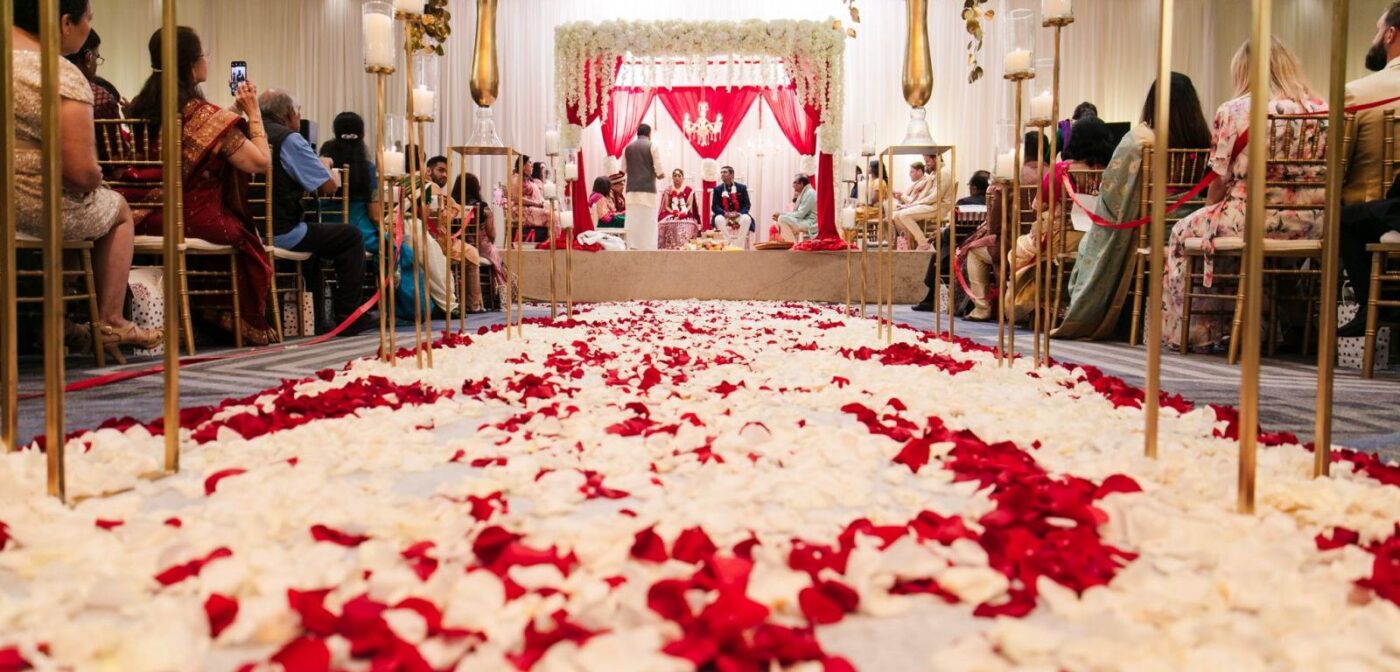
Most event vendors in Dallas–Fort Worth have a template for a wedding, a corporate party and a child’s birthday. Very few have one for a Shashtiabdapoorthi or a Sathabhishekam — the ritual milestone birthdays South Indian families hold when a parent completes sixty or eighty years. If you are planning a 60th or 80th birthday celebration in Dallas and a vendor has told you it is “just a birthday party,” that is the first thing to correct. It is a priest-led ceremony with a fixed start time, followed by a meal and a reception, and the audio decisions for those two halves are close to opposites.
This is a different job from the 25th or 50th wedding anniversary party covered in our guide to planning a milestone anniversary party in Dallas. An anniversary party is a reception with no ceremony attached, so the whole evening belongs to the host and the DJ. This event has a priest, a homam, a muhurtham-style fixed time, and a first half where the correct amount of music is almost none. Treating the two as the same booking is how families end up with a sound system pointed at the wrong part of the day.
What a Shashtiabdapoorthi or Sathabhishekam Actually Is
Families and regions name these differently, and your priest — not a vendor — decides which ceremony is being performed and when. Broadly, three milestones are commonly observed in Tamil, Telugu, Kannada and Malayali families:
- Shashtiabdapoorthi (also written Shashti Poorthi, and often paired with the Ugra Ratha Shanti rites) at the completion of sixty years.
- Bhimaratha Shanti at seventy, observed by some families and skipped by others.
- Sathabhishekam at eighty — traditionally reckoned by a thousand full moons rather than by the calendar, which is why the date usually lands some months past the eightieth birthday.
The structure is recognisably a wedding. The couple sit together, a homam is lit, the priest performs the rites, the mangalsutra or thaali is re-tied, and the children and grandchildren pour the abhishekam and offer garlands and blessings. That is the point of the ritual: the marriage is renewed and the elders are formally honoured by the generation below them.
Two practical consequences follow immediately. First, the ceremony has a fixed auspicious time, the same non-negotiable constraint that shapes a South Indian wedding day — the same discipline described in our piece on what makes a South Indian wedding different. Setup finishes before it, not during it. Second, because the ceremony is usually held in the morning, the whole event often ends by mid-afternoon. A vendor quoting you a standard evening reception has not understood the shape of the day.
Do not let any vendor, including this one, tell you the date. The muhurtham and the thousand-full-moon reckoning come from a panchang and from your family priest. Confirm the date and the start time with them, then work every load-in and sound-check time backwards from it.
The Ceremony Half: The Sound Job Is Restraint
Almost everything that goes wrong in the first half of these events comes from someone treating it like a function that needs a soundtrack. It does not. What it needs is speech that carries.
Music off, mics on
During the homam and the rites, background music is out. What the room needs is to hear the priest — and priests move. They sit, they stand, they turn toward the fire, they turn toward the couple, and they speak at conversational volume while chanting in Sanskrit or Tamil. That is a microphone problem, not a playlist problem. Ask the family whether the priest is comfortable being mic’d at all; many are, some are not, and the answer changes the whole plan.
Live musicians, if there are any
Some families book Nadaswaram and Thavil players for the ceremony, exactly as they would for a wedding. If so, the players own that audio, and the job is to stay out of their way — no reinforcement unless they ask for it, and no recorded music layered over them. If there are no live musicians and the family wants sound, the correct answer is usually low-level instrumental or devotional audio before the ceremony begins and silence once it does. Ask, do not assume. Some families want nothing at all.
Volume for the room that is actually in it
This is the one audience consideration that separates a good operator from a loud one. The front rows at a Sathabhishekam are the honoree’s own generation. Hearing aids are common, the room is often a hard-surfaced hall, and a system set to wedding levels is genuinely painful rather than merely loud. Trim the low end rather than turning everything down — bass is what rattles a hall and what overwhelms a hearing aid — and check the far corners and the front row separately.
Your Client Is the Adult Children, Not the Honoree
Like the anniversary party, this event is organised for the guests of honour by their adult children, which means the people paying and the people being celebrated are different. Often three or four siblings are involved, sometimes across time zones, and often at least one of them is also managing the priest, the caterer and the hall.
Insist on one named night-of contact who is authorised to make calls, and get that name in writing before the day. Not the eldest sibling by default — whoever is actually going to be in the room and reachable while the ceremony is running. On the day, the honorees themselves should never be asked to approve a running-order change; that is the whole point of the event.
Be direct about surprises, too. If there is a surprise element — a grandchild’s performance, a video message from relatives in India, an unexpected guest — the sound operator needs to know even if the honoree must not. A surprise nobody briefed becomes dead air and a scramble at the exact moment the family wanted a photograph.
Building the Music Around the Honoree’s Era
The single biggest musical mistake at a 60th or 80th birthday celebration in Dallas is programming for the room’s median age instead of the honoree’s. The couple being honoured are the guests of honour for a few hours once in their lives. The music after the ceremony should be anchored to their decades, not to the cousins’.
Work it out arithmetically rather than by feel. A sixtieth in 2026 means someone born around 1966 who likely married in the late eighties or early nineties — so Ilaiyaraaja’s peak, S. P. Balasubrahmanyam, K. J. Yesudas, S. Janaki and Chitra, and the Hindi film music of that same stretch. An eightieth means someone born in the mid-forties who married around 1970: T. M. Soundararajan and P. Susheela, Ghantasala for Telugu families, M. S. Subbulakshmi and devotional repertoire for the quieter parts of the day, and Rafi, Lata, Kishore and Asha on the Hindi side.
A few things that consistently earn their place:
- The couple’s own wedding-era songs, if anyone in the family can name them. Ask early; it takes a week of phone calls among relatives and it is the best two minutes of the day.
- Devotional and Carnatic selections as meal music. This is not filler — for a room of elders eating lunch after a ceremony it is exactly right, and it keeps conversation possible.
- A clean copy of anything that matters. Mid-century film audio circulates in poor transfers. If a specific song is going to underscore a moment, source a good version in advance rather than pulling whatever appears first in a search.
Language matters as much as era. A DFW family gathering may be Tamil, Telugu, Kannada or Malayali, or a mix across in-laws, and the honorees’ comfort language is not always the one the grandchildren speak. Ask which languages are actually in the room and in what proportion, rather than defaulting to Hindi film music because it is the largest catalogue.
The Program: Speeches, Slideshows and Grandchildren
The second half of the day is a program, and it is speech-heavy by nature. Every child and most grandchildren want to say something, and the tributes are the emotional centre of the event, not an interruption to be minimised.
That makes it an audio job with a few predictable failure points:
- More handheld mics than you were told. Plan on at least two live and a spare. A single mic passed down a line of eight family members burns ten minutes in handoffs.
- The slideshow. Almost every one of these events has one, almost every one has audio, and almost nobody sends the file in advance. Get it days ahead, in one file, and test the audio path through the actual system at the actual venue — not on a laptop speaker.
- Grandchildren’s performances. Dance items and songs need the same discipline as any family performance: one edited file per act, the exact rehearsed cut, named by act, sent ahead. Our guide to performance cues and audio-file discipline covers that in full, and every rule in it applies here.
- Underscore volume. Soft instrumental music under a tribute works beautifully and ruins the moment if it is even slightly too loud, because the speaker is usually not a confident public speaker and will not push over it.
Build in the physical beats as well as the spoken ones: the garlanding, the children touching the honorees’ feet, the group photographs by family branch. These take longer than anyone estimates and they are what the family will look at in ten years. Give the photographer room and do not let the program run over them.
Venue Logistics in Dallas–Fort Worth
These events land in three kinds of room across the metroplex: a temple or community hall, a banquet hall in Irving, Plano, Frisco or Richardson, or occasionally a large home with a tent for the ceremony. Each behaves differently, and the constraints are worth confirming in writing rather than assuming:
- Load-in against a fixed muhurtham. A morning ceremony means an early load-in, often before the venue’s usual staffing. Confirm the access time directly with the venue, and confirm who will actually be there to open the door.
- The homam and the room. A sacred fire indoors raises questions about ventilation and fire policy that only the venue can answer. Ask early — it is the family’s conversation to have with the hall, not a detail to discover on the morning.
- House PA versus a brought-in system. Many halls have a ceiling system built for announcements. It is often adequate for a priest and useless for music. Decide which system carries which part of the day before load-in, not during it.
- Power. Confirm the circuits available where the equipment will sit, particularly if a caterer is running warmers off the same wall.
- Amplified-music end time. Confirm it with the venue directly. It does not move because the ceremony started late.
Does This Event Even Want a Dance Floor?
Often, no — and a vendor who pushes one is selling rather than planning. Many Shashtiabdapoorthi and Sathabhishekam celebrations finish with lunch, photographs and conversation, and that is a complete and appropriate event.
When there is dancing, it is usually a short, bounded block after the meal: half an hour to an hour, opened by the grandchildren, with folk and film music the honorees recognise rather than current releases. Sequence it oldest-first, exactly as you would at a community celebration, because the honoree’s own generation will not be on the floor at ten o’clock. If the younger half of the family wants a later, louder party, that is frequently a separate evening event with its own booking — worth naming as a choice rather than trying to make one afternoon do both jobs.
A Running Order That Works
Adjust the clock to your own muhurtham, but the shape holds:
- Load-in and sound check — finished and quiet well before guests arrive.
- Guest arrival — low-level instrumental or devotional audio, mics tested and set aside.
- Ceremony — recorded music off. Priest mic’d if the family agrees; live musicians own the sound if present.
- Abhishekam, garlanding, blessings — no music over it unless the priest or family explicitly asks.
- Photographs by family branch — the most underestimated block on the schedule.
- Lunch — room-tone music at conversation level. Era-appropriate, low.
- Program — one emcee, a capped speaker list, one named person authorised to close the block, slideshow, grandchildren’s performances.
- Optional short dance block — opened deliberately, sequenced oldest-first.
- Close — a final track and a thank-you from the family, worked backwards from the venue’s music cutoff.
What to Ask Before You Book
Most of the contract questions in our guide to what to ask a Dallas DJ before you sign apply unchanged — whose name is in the contract, what the backup equipment actually is, what happens if the event runs long. Four questions are specific to this event:
- Have you worked an event with a priest-led ceremony where the correct answer during the rites was silence?
- How will you mic a priest who moves, and what is the plan if he prefers not to be mic’d?
- Can you source and program film and devotional music from the nineteen-sixties and seventies, in the languages our family actually speaks?
- What do you need from us in advance, and by when? A vendor who cannot answer this precisely will be asking for the slideshow file on the morning.
Planning a 60th or 80th Birthday Celebration in Dallas
A Shashtiabdapoorthi or Sathabhishekam rewards planning more than it rewards production. The ceremony wants a clear microphone and no music. The meal wants the honorees’ own decades at conversation volume. The program wants enough mics, a slideshow that was tested, and a running order that leaves room for the photographs. Get those four things right and the afternoon does not need anything else.
DJ Jazz Entertainment has worked events across Dallas–Fort Worth for more than twenty-five years — weddings, corporate and cultural functions and private family celebrations — providing DJs, MCs, dhol, sound and lighting across Dallas, Irving, Plano, Frisco, Richardson and the surrounding suburbs. If you are planning a 60th or 80th birthday celebration in Dallas for your parents, tell us the muhurtham and the shape of the day and we will build the sound plan around it.
